Category: Printing

  • Roll Labels Vs Sticker Sheets: Which Is Better For Packaging?

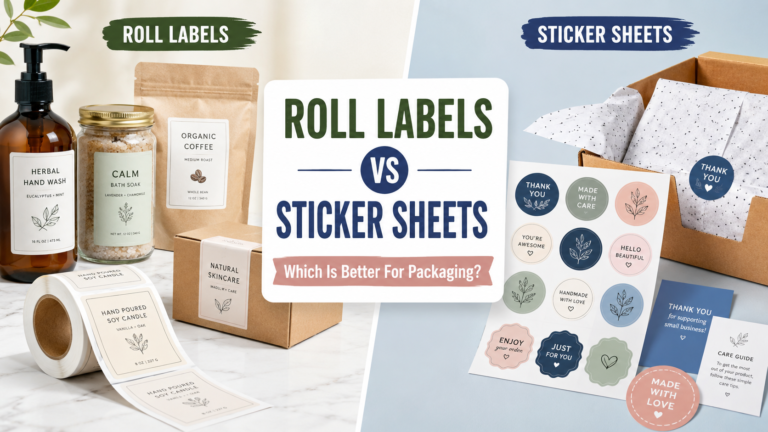
    Roll Labels Vs Sticker Sheets: Which Is Better For Packaging?

    TLDR

    Roll labels are usually better for packaging when you need to label jars, bottles, boxes, bags, pouches or mailers at any real volume.

    Sticker sheets are better when you want multiple small stickers on one page, want to include a branded sticker insert or need a flexible option for small batches, product samples or creative packaging kits.

    For most product packaging, choose roll labels. For unboxing extras, sampler packs and multi-design brand moments, choose sticker sheets.

    Roll Labels Vs Sticker Sheets: The Quick Packaging Answer

    A label feels simple until you are standing over 400 jars, trying to peel and place each one straight before an order ships. That is usually the moment the format starts to matter.

    For most packaging jobs, roll labels are the better choice. They are easier to peel quickly, easier to store in bulk and better suited for repeated product labels, barcode labels, ingredient labels, logo seals and branded packaging stickers. If you are labeling the same container again and again, roll labels usually make the workflow cleaner.

    Sticker sheets still have a real place. They work well when packaging needs several different stickers on one sheet. Think thank-you stickers, size labels, QR code stickers, logo marks, limited edition badges or small decorative accents that go inside a package. They are also useful for small-batch brands that want one sheet with several designs instead of committing to separate rolls.

    So the real answer to roll labels vs sticker sheets is not “one is always better.” It is this: roll labels are better for production packaging. Sticker sheets are better for flexible, multi-sticker packaging and branded inserts.

    For a broader look at packaging label use cases, PrintingRay’s guide to packaging labels and product labels is a useful next read.

    What Are Roll Labels?

    Roll labels are individual labels printed on a continuous backing liner and wound around a core. You peel one label from the roll, apply it to the product or package and keep moving.

    That format sounds basic, but it solves a very real packaging problem: repetition.

    Roll labels are commonly used for:

    • Bottle labels
    • Jar labels
    • Candle labels
    • Box seals
    • Mailer stickers
    • Pouch labels
    • Bag labels
    • Barcode labels
    • QR code labels
    • Ingredient labels
    • Logo packaging stickers
    • Product warning labels
    • Batch or SKU labels

    They can be applied by hand, with a label dispenser or with a label applicator. That makes roll labels a good fit for brands that are growing beyond “I made ten of these at my kitchen table” but are not necessarily running a huge packaging line either.

    Roll labels also make reorders simpler. If you sell the same hot sauce, candle, lip balm, coffee bag or supplement bottle every month, having that product label on a roll keeps the packaging process consistent.

    What Are Sticker Sheets?

    Sticker sheets are flat sheets that hold multiple stickers on one backing sheet. Most sticker sheets are kiss cut, which means the top sticker layer is cut but the backing sheet stays intact.

    That makes them handy for grouped designs. One sheet might include a logo sticker, a thank-you sticker, a social media sticker and a small QR code sticker. Another sheet might include several product variant stickers for small packaging runs.

    Sticker sheets are often better for:

    • Branded unboxing inserts
    • Small decorative packaging stickers
    • Sample kits
    • Limited edition packaging
    • Multiple product variants
    • Handmade product batches
    • Market booth packaging
    • Sticker freebies
    • Creator merch
    • Promotional packaging packs

    Sticker sheets can be used for packaging labels, but they are not usually the fastest format if every package needs the same exact label. They shine when the sheet itself is part of the packaging experience.

    PrintingRay’s article on die cut, kiss cut and sticker sheets goes deeper on how sticker sheet formats work.

    Packaging Speed: Roll Labels Usually Win

    If speed matters, roll labels are usually the better packaging choice.

    A roll is easy to hold, feed, peel and apply. You can keep the roll at a packing station and move through a batch without handling full sheets. If your team uses a dispenser, the backing bends away from the label, making each label easier to grab.

    Sticker sheets are slower for repeated packaging. You pick up a sheet, peel from one area, apply the sticker, set the sheet down and repeat. That is fine for small batches. It can get tedious once you are labeling dozens or hundreds of identical packages.

    A practical rule:

    If you are applying the same label more than 100 times, strongly consider roll labels.

    If you are applying a few different stickers in different places, sticker sheets may feel easier and more organized.

    Cost And Quantity: Think In Repeat Use

    Roll labels often make more sense as quantity increases. They are built for repeated use, compact storage and efficient application. The more often you use the same label, the more attractive the roll format becomes.

    Sticker sheets can be more practical when you do not need many of each design. Instead of ordering five separate rolls for five small sticker designs, you can place those designs on one sheet. That can be a smart move for seasonal packaging, test products, event kits or early-stage branding.

    Here is the simplest way to think about cost:

    Packaging NeedBetter FormatWhy
    One repeated product labelRoll labelsFaster and easier to apply in batches
    Several small stickers togetherSticker sheetsKeeps multiple designs on one page
    High-volume labelingRoll labelsBetter workflow and storage
    Small test runSticker sheetsMore flexible for varied designs
    Product samples or kitsSticker sheetsGood for mixed stickers and inserts
    Machine or dispenser applicationRoll labelsDesigned for that kind of workflow

    Cost is not only the print price. Labor matters too. A slightly cheaper format can become more expensive if it slows packing or creates crooked labels.

    Design Flexibility: Sticker Sheets Give You More Variety

    Sticker sheets are the better format when the packaging design uses several separate pieces.

    For example, a candle brand might use:

    • One front label
    • One scent sticker
    • One warning sticker
    • One thank-you sticker
    • One small logo sticker for tissue paper

    If all of those are used in different ways, a sticker sheet can keep the project tidy. The packer grabs one sheet and has every piece needed for that order. That is especially helpful when you are assembling gift boxes, subscription boxes or handmade product bundles.

    Roll labels are better when each label has one job. A front jar label. A tamper seal. A shipping box logo. A barcode. A nutrition panel. One purpose, repeated many times.

    Neither format is more creative by default. Sticker sheets just give you more layout flexibility on one printed piece.

    Material And Durability: Match The Label To The Package

    The format matters, but the material matters just as much.

    For packaging, common label materials include paper, vinyl and BOPP. BOPP is often used for product labels because it can handle moisture, oils and frequent handling better than standard paper. That matters for products like drinks, sauces, skincare, bath products, candles and refrigerated goods.

    A few practical examples:

    Use a durable film label for products that may face condensation, oils or frequent handling.

    Use paper labels when the product is dry, the packaging is simple and the label does not need much moisture resistance.

    Use clear labels when you want the container to show through, especially on glass jars, bottles or clear packaging.

    Use matte or gloss laminate depending on the look and handling needs.

    Roll labels and sticker sheets can both be made with durable materials, depending on the printer and product specs. So do not choose based on format alone. Choose based on where the label goes, how the package is handled and what the product may touch.

    Storage And Packing Station Setup

    Roll labels are compact. They sit neatly in bins, drawers, shelves or dispensers. This matters more than people expect. Packaging stations get messy fast, and loose sheets can curl, bend or get separated by design.

    Sticker sheets are easier to view at a glance. That can be helpful when you have several small stickers and want packers to see every option on one page. The downside is that sheets take up more flat storage space and can be less convenient in high-volume packing.

    For a clean packing station:

    Use rolls for repeat labels that live at the station every day.

    Use sticker sheets for inserts, seasonal stickers, small batch variants and bundled packaging pieces.

    That setup gives you the best of both formats without forcing one format to do everything.

    Which Format Is Better By Packaging Type?

    Bottles, Jars And Cans

    Roll labels are usually the better choice. Bottles and jars need consistent placement, especially if the label wraps around a curved surface. Rolls are easier to use with dispensers and applicators, and they make batch labeling less painful.

    Sticker sheets can work for small handmade runs, but they are not ideal if you are labeling the same container again and again.

    Boxes And Mailers

    Roll labels are best for logo seals, box labels, shipping-related labels and branded closure stickers. You can keep a roll at the packing table and use it all day.

    Sticker sheets are better if you want to include a small set of branded stickers inside the box as part of the unboxing experience.

    Pouches And Bags

    Roll labels are usually better for coffee bags, snack pouches, supplement pouches and retail bags. These packages often need front labels, back labels, batch labels or flavor labels.

    Sticker sheets can work for small-batch flavor stickers or limited edition packaging where you need several variations in one place.

    Subscription Boxes And Gift Sets

    This is where sticker sheets get more interesting. A subscription box might use several sticker moments: one on tissue paper, one on a product card, one on a sample bag and one as a freebie.

    For that kind of packaging, sticker sheets can help keep the packout organized.

    Food, Cosmetics And Regulated Products

    Roll labels are often the cleaner choice when a product needs consistent ingredient lists, nutrition facts, usage directions, warnings or manufacturer information. For food products, make sure the label layout leaves room for required information and readable type.

    This is not a place to wing it. If a label needs legal or regulatory information, check the requirements before printing.

    Common Mistakes To Avoid

    The first mistake is ordering sticker sheets for a job that is really a repeated product label. It may seem convenient at first, but the application process gets slow once volume grows.

    The second mistake is ordering roll labels when you actually need a branded sticker pack. If the goal is to give customers several fun stickers inside the package, a roll is awkward. A sticker sheet feels more intentional.

    The third mistake is ignoring the container surface. A label that works on a flat box may not behave the same way on a curved bottle, squeezable pouch or oily cosmetic jar.

    The fourth mistake is going too small with required text. Packaging labels often carry important details. If the text becomes hard to read, the label may look cluttered and may create bigger problems for regulated products.

    The fifth mistake is choosing only by price. Packaging labels affect the customer’s first impression, but they also affect packing labor. A format that saves a few dollars upfront may cost more in time.

    Final Recommendation

    For most packaging, roll labels are the better choice. They are faster to apply, easier to manage in bulk and better suited for repeated product labels. If you are labeling jars, bottles, bags, pouches, boxes or mailers with the same design, start with roll labels.

    Choose sticker sheets when the packaging needs variety. They are great for inserts, small-batch branding, sampler kits, seasonal stickers and grouped packaging accents. They also make sense when one sheet can hold several small designs that would be annoying to order as separate rolls.

    The best setup is often both: roll labels for the main packaging and sticker sheets for the little brand moments customers remember.

    FAQs

    Are Roll Labels Better Than Sticker Sheets For Product Packaging?

    Yes, in most cases roll labels are better for product packaging. They are easier to apply in batches and work well for repeated labels on bottles, jars, boxes, pouches and mailers.

    Are Sticker Sheets Good For Packaging?

    Sticker sheets are good for packaging when you need multiple small stickers, branded inserts, sampler labels or decorative unboxing elements. They are less efficient for applying the same label hundreds of times.

    Can Sticker Sheets Be Used As Product Labels?

    Yes, sticker sheets can be used as product labels, especially for small batches or handmade products. For larger runs, roll labels are usually easier to apply and reorder.

    What Is Better For Small Business Packaging?

    For a small business, use roll labels for your main product labels and sticker sheets for extras like thank-you stickers, QR code stickers, freebie stickers or limited edition designs.

    Do Roll Labels Work With Label Applicators?

    Yes, roll labels are commonly used with label dispensers and applicators. This is one reason they are often preferred for production packaging and repeated labeling tasks.

    Should I Use BOPP, Vinyl Or Paper For Packaging Labels?

    Use BOPP or another durable film when the product may face water, oil, condensation or frequent handling. Use paper for dry, simple packaging where durability is less important.